Tuesday, March 16, 2010

Aviva Ironman 70.3- Race Day Do's and Dont's

Dear Aviva Ironman 70.3 Athletes,


I hope your taper is coming along nicely and that you didn’t ride too hard or too long weekend. It was nice to see so many of you out there on the road getting comfy in your aero- tuck. 7 days more- Aviva Ironman 70.3 is definitely in the air and you should be getting excited!

You may start to feel a little more tired and sore and lethargic- Don’t worry! This is simply your brain telling your body to ease off in this final week as it winds down into “rest and repair” mode. Your job this week is to keep on “teasing “ your arms, legs, heart and lungs with a bit of work in all the 5 systems; Speed, Tolerance, Neuromuscular, Endurance and Strength, so that they stay hungry for more, while giving them ample time to recover.


Here’s a check list that will help you have a successful day.

Pre- Race

DOs:

  • Send your bike in for a service. Look for frayed cables, cracked sidewalls and cuts in the tyres, a worn chain (I just changed mine and it rides like a dream), squidgy brakes. Check that the spoke tensions are equal and that the shifting is accurate. Tighten all the screws in your cleats and all the ones holding your cockpit together.
  • Get some new goggles (nice to see where you’re going) and try them out at least once in the coming week.
  • Get a massage in the first half of the week.
  • Add salt to your food. Start stockpiling Sodium and Magnesium in your body. With this weather we’ve been having, you’re gonna lose a ton of it out there.
  • Stay well- Like a finely tuned F1 super-car, the fitter you are the more susceptible you are to picking up bugs and nasty infections resulting in fevers, colds, gastric, diahohreah, vomiting. Eat well, load up on Vitamin C and get that extra hour a night of sleep.
  • Work out in detail your nutrition plan for raceday- How much of what are you going to carry and where are you going to carry it?
DON’Ts:
  • Change the height/ position of your saddle! 
  • Stuff your face for 3 days going into the race to “Carbo-Load”. A sensible diet in the week, with a full meal on Friday night or Saturday lunch will ensure that your glycogen (energy) stores are full and that you’ll have time to clear out any access.
  • Don’t go overboard with hydration using plain water. The access will flush out salts along with it. Go for moderate amounts of sports drink instead.
That is a lot to keep in mind during the final week. Truth is, getting to the start line of any long course triathlon is really half the battle. Once the horn goes off, it really should feel like a hard training day with lots of friends all in their very best gear!

Race Day

DOs:

  • Start the day with a simple breakfast that’s easy to digest. This is just to get the digestive juices flowing.
  • Have 2 glasses of water to hydrate the liver.
  • Bring a snack to munch on as you set up in transition. You might be there for upto 2 hrs before the horn goes off. So stay topped up nutritionally, sip at a sports drink and have a gel before the race for a mental and physical advantage.
  • Do line up in the appropriate place on at the start. If you’re not that strong a swimmer, it’s a better idea to line up towards the rear so that you can calmly take your bearings and look for a suitable draft before hitting the water. Place yourself too far forward and you’ll get a ton of people swimming over you (an experience similar to drowning).
  • Sight frequently- look where you’re going. Don’t rely on the blindly following the person in front of you- he might be charging towards the wrong buoy.
  • Find a draft in the water. It saves energy.
  • Go out easy on the bike and build into your ride. The 3 lap course makes for easy pacing. Easy- Moderate- Comfortably Uncomfortable. (Read that last one again and then go think about it.)
  • Eat on the bike. As a rule of thumb, aim for 200 calories an hour. Remember you need to run a half marathon after you get off the bike. On your training rides, one gel an hour may get you comfortably to the end of the ride (at which point you then proceed to pig out), but on race day, you’re eating for the run. You can never absorb as much calories as you burn while you’re on the go, so you’re eating to minimize the calorie deficient in order to keep from bonking on the run.
  • Get out of the saddle from the aero position once in a while to give your butt, back and legs some relief. The climbs are a good place to do this.
  • Be responsible. Ride Safe. There are others out there enjoying their big day. Don’t take unnecessary or stupid risks by squeezing into little spaces or getting caught in the position where you need to slam on the brakes. Yes, it’s a race, and we want to put out our best effort and yes we also want to finish the race!
  • Do call out if you’re passing but don’t swear in the same sentence.
  • Start the run easy with small, light steps. This will help you get used to the change from riding to running. Stay easy, and don’t try to force the pace. Your rhythm will come as you progress into the run. Run conservatively and only as fast as you can while holding your form you’ll be grateful later on.
  • Keep eating on the run, keep taking salt. The weather recently has been hot and nasty, you’ll be losing a ton of salt.
  • Smile- It helps with the pain, seriously.
  • Stop early and stretch out properly if you get that crampy feeling. Don’t wait till it’s too late.
  • Always thank the volunteers and be nice to them. They’re out there for you.
  • Do push yourself in the closing stages of the race. Keep your eyes fixed on the runner in front of you and try to pull them in.
DON’Ts:

  • Don’t be afraid to sprint up to the next guy ahead to swap for a faster draft- could be worth it!
  • Don’t hit back when you get hit/ punched/ grabbed. It’s nothing personal. Open water is not the place to lose your temper- for safety reasons as much as for energy conservation ( think of your skyrocketing HR, as the adrenalin kicks in if you decide to retaliate- what a waste of energy). There are hundreds of other arms flailing about out there in the murky waters, it’s not anyone’s fault. Just stay calm and get out of each other’s way and hang in there. The field will soon thin out.
  • Don’t worry that your heart is absolutely pounding by the end of the swim leg. The sudden change from a supported horizontal position to a vertical position will make you think you’re having a heart attack. This is normal, take an easy jog easy to your bike and think about getting through T1 quickly.
  • Don’t chug half a bottle of water/ electrolytes/ sports drink in the transition. This will quickly end up sloshing about in your stomach. Don’t stuff your face with an energy bar/ slurp down a double caffeinated gel. There’s plenty of time to feed on the bike. Give yourself sometime to settle down on the bike before you start nibbling away.
  • Don’t try the “jumping onto the bike with the shoes clipped in” thing unless you have practised this. You could end up with a bloody toenail-less toe.
  • Don’t hammer it out of T1 even if you feel great. Your girlfriend/ wife/ kids will be impressed but your legs will be flooded with Lactic Acid right at the start.
  • Don’t spend all day steering from your elbow pads. If you are unable to stay seated comfortably in the aero position for most of the race, then it’s not very aero, right? Book an appointment with me to get fit properly after the race.
  • Don’t be afraid to adopt a structured run/walk strategy. By imposing regular breaks, you’ll be able to run with better form for the duration of the half marathon.
  • Don’t throw your Powergel wrappers on the floor : )

That’s all from me, I wish you all the very best on race day and look forward to seeing you smiling out there!

And to my ironguides/ TrackAttack athletes- "ALL OUT!"
Shem

Athlete’s Circle/ ironguides Coach- Singapore

**Your Best is our Business**

shem@athletescircle.com

shem.leong@ironguides.net

Tuesday, March 9, 2010

Aviva Ironman 70.3 Singapore Training Camp

Aviva Ironman 70.3 Singapore Training Camp
(26-28 Feb 2010, Changi Beach Club)

conducted by ironguides Head Coach Vinnie Santana and Singapore coach Shem Leong.


Monday, March 8, 2010

Final Preparation for Aviva 70.3 Pt 1: The Taper

Dear Aviva Ironman 70.3 Athletes,

At this stage of preparation, with the months of hard work behind you and a mere 2 weeks until the big day, you should all be close to your fittest now. You’ve done the late night track sessions, given up a social life for 5am bike rides, and rushed to the pool after work to get a swim in. Well Done! There’s not a lot more you can do to improve your fitness but how do you taper just right to get to the start line in peak form, feeling fantastic and raring to go? Too much rest could see you feeling flat and lethargic while increasing or even maintaining your current training load may not give your body a chance to fully recover.  

Remember that training session when you were able to hammer it up climb and drop the rest of the gang? Or what about when you felt like you were flying over the last few kms of a supposedly long easy run? Or that night when you could have swum forever? You may not have known it but at these times, when you were “in the flow” and your energy and power came effortlessly and in abundance, you might well have been “Peaking”- Triathlon’s “aligning of the stars”- where mind, body and soul are all in sync, brining you to powerful place where physical performance and self confidence are both riding high.

How can we time this peak for Race Day? What can we do to get to the start line with that unstoppable feeling? In my experience many factors help us to bring on a peak. One of the most important ones is getting the taper right.

Tapering:

At this stage, 2 weeks out, hopefully you have just finished a solid block of hard training and are feeling pretty fatigued. Taper is a period of reduced training load designed for your body to rest and repair while all the physiological adoptions occur. You may have heard some athletes talk about “soaking up” all the hard work- this is what they are referring to. Taper right and you will get to race day feeling fresh, full of energy and raring to go. If you train between 8- 13 hours a week, I recommend a 10 day taper. A shorter taper is needed is you train less than this.

Here are some general rules of thumb that I use in planning my athlete’s programme. Hope you find them useful!

a.    Tapering is not a period of complete rest. 10 days of doing nothing will see you very well rested up, but also feeling flat, lethargic and possibly carrying a few extra kilos. We all know you triathletes can eat!

b.    Keep the training sessions regular- the same frequency as before. Instead of skipping full days of training to get Rest, head out there as many times as you would do on in a normal week. Keeping the training stimulus regular will keep the engine purring instead of turning off the ignition altogether. You can also use the extra time stretching to make sure you stay supple.


c.    Reduce the volume. A safe rule that is commonly used is to reduce training load to 50% of total, 10 days out, and to further half it (25% of total) in the last week. For example, if you usually do a 16km run on a Sunday, run 8km 2 weeks out and then 4 km the week before. 

d.    Keep some intensity in there- a light 15 min jog will work up a light sweat but it’ll do little to activate the upper limits of your cardiovascular range that you have worked hard to achieve. By keeping some intensity in your training with short sharp intervals, you will still be stimulating all the right systems used on race day. Gaseous exchange, aerobic and anaerobic respiration, muscular strength, neural firing patterns, elasticity of connective tissue, cellular energy production; these are some of the important systems that you will continue to activate (in small doses) during taper to keep them ticking over. Here are some sets for you to try out that should do the trick:

i.    15 x 400m run with 45sec rest interval. 4 easy, 4 moderate, 4 comfortably uncomfortable and the last 3- HARD.
ii.    7 x 200m in the pool with 20sec rest interval- 3 easy, 2 moderate and the last 2 All Out 
iii.    1.5 hr easy- moderate bike with 3 x 8 mins All Out time trial efforts thrown in randomly.  

e.    Watch what you eat during taper, especially in the last week where training load is cut down drastically. Remember that your calorific burn rate is cut down as well so you don’t need to, and won’t get away with, stuffing your face after a short session. In fact, because of the reduced training load, you would be storing glycogen (carbohydrate stores) just by eating the same portions. No need to pig out at the pasta Party. If there ever was a time to eat healthy, that would be now.

f.    All the training sessions that you put in the last week/ 2 weeks, should leave you “wanting more”. Mentally this allows you to put aside something for race day. Physically, you want to perform the sessions hard enough just to tease out the right physiological response to keep that system ticking over. Don’t kill yourself on any sessions during this time to “test your fitness”. Trust in the many hours that you have already put in, overdoing any training session will hamper your body’s ability to recover fully.

g.    It’s weird but the fitter we are, the more easily we get sick. Top up on Vitamins and Anti-Oxidants to keep our immunity high.

In Part 2, I’ll be sharing more on preparing for the big day in terms of  nutrition, pacing, and some other important Do’s and Don’ts- So stay tuned!

Feel free to drop me a note if you have any thoughts on this newsletter.

Enjoy your Training!


Shem Leong
Athlete’s Circle Coach
ironguides Singapore
shem@athletescircle.com

Wednesday, February 24, 2010

Decisions, Decisions

Life is full of decisions and I have been faced with my fair share recently.


To the unfamiliar, my decision to race the 2010 Chapter of the Aviva Ironman 70.3 would seam like a pretty trivial decision- If I can finish it, why not jump in and give it a go, have fun doing it and enjoy the race?

But those that know me, know that I enjoy the race in a different way.

I love to race. I love to set PB’s and push myself to new levels. This is what I enjoy doing. I race when I know that I’ve put in my best efforts into planning & training & recovering- in short, I love chasing that perfect race. I’ve had that experience a few times now and not much comes close to putting out your absolute best effort on the day, having worked hard at it for the preceeding months. That is how I respect the sport. It has given me so much ( a story for another day perhaps), that just to jump in for the sake of it would be selling myself short.

This time round however, I feel that I haven’t been able to give my best effort. There’s a whole lot of other stuff going in the background- growing up stuff, career stuff, getting married stuff, Church stuff. So my brain is telling me to let go of this one and forget about 70.3. But my brain is also telling me that everyone else has “stuff” too; why should I be excused from “stuff”?

As triathletes, we all juggle too many things than we should and we want to be good at all of them- swimbikerunworkfamilykidsrelationshipssociallife anyone? But thats who we are, thats we we love it. The sheer audacity of pulling out a sub 5 hr half-ironman while keeping everything else undercontrol- Well, that’s something special!

So I set myself some tasks this weekend to get a sense of where I’m at fitness wise; Saturday-90km TT, Sunday- 12ks worth of trail intervals. Nothing superhuman (to be expected) but not too shabby either. There’s a little bit of time left- am I dreaming to think that a few good sessions, a sensible diet and some tightening up of the core will get me to the start?

We'll see you there!

Shem


7am, Macritchie Carpark

Wednesday, January 27, 2010

Running the good race.

Standard Chartered Singapore Marathon 2009

Shem Leong

It’s been 2 days since the 2009 Standard Chartered Marathon and the endorphins are finally returning to normal levels. Vibrant flashbacks of a fantastic run are merging into a single memory to remind me of the significance of this race.


3 weeks ago I was sidelined with a pulled left calf. It was my 1st real running injury and a healthy dose of humble pie. Turns out I am not invincible; overloading coupled with inadequate warm up is a recipe for disaster!


Disappointment and frustration followed me around everywhere as I felt my peak form slip away. Unable to train and taper properly, I felt the looming uncertainty that lay around the corner at December 6. In the meantime, I was on my feet, giving running lectures, 3 days in a row at the race expo. Not the ideal preparation at all!


It was with lowered expectations that I lined up at the start. Somewhere deep in my heart, I still wanted to come in under 3:15. But, all things considered, I told myself to be happy with a 3:45. My calf was not quite 100% and I had definitely lost some cardiovascular condition. What the heck! A 2 time Ironman World Champion once told me, “Never give up!”


The horn goes and we’re off down the road- the loud disco-pop giving way to the resigned pitter-patter of thousands of expectant feet. I settle into a nice light rhythm.


“Start Easy, Stay Easy” I tell myself. This is a line straight out of one my lectures. Time and again, during the course of this run my belief in my own running principals and coaching methods would be put to the test.


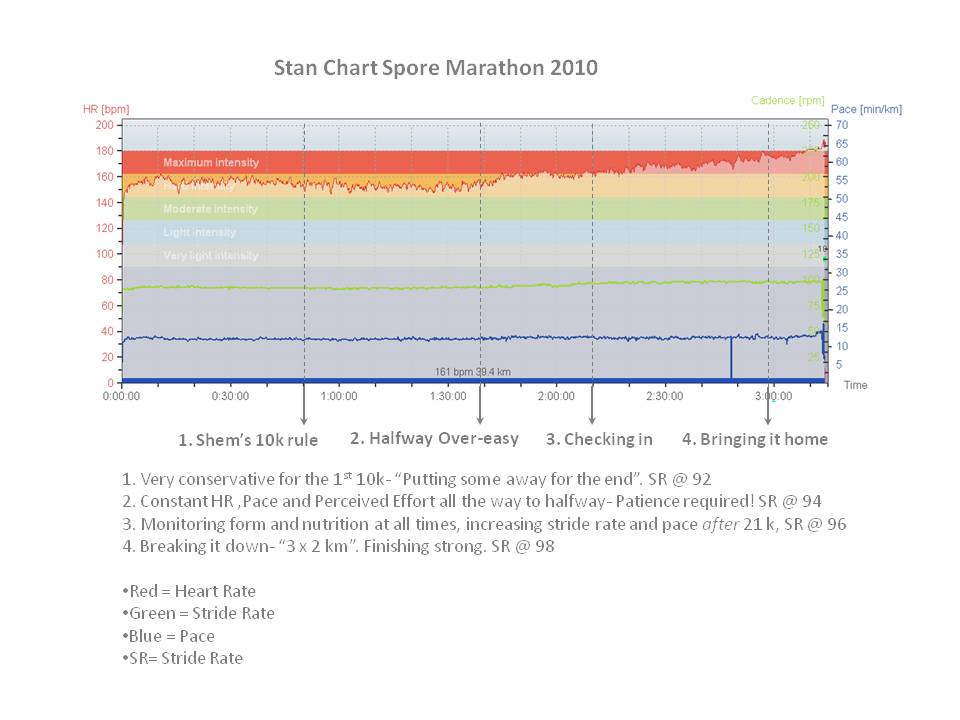
1. Shem’s 10km rule: Get the 1st 10 k out of the way without even feeling it.


“What 10?”

I thought as I passed the marker. Starting at a very conservative pace, I was conscientiously restraining myself from picking up the speed. So far so good- 10 km effortlessly down and my race had suddenly become a much more manageable 32 Km.


2. Halfway Over-Easy: Keep it easy to at least half way.


Keeping the same easy pace all the way to 16km had me feeling good. I had been “putting something aside” for the end of the race, but now, the first whispers of doubt interrupted my regular 2- 2 breathing pattern, “Too slow, you’re not going to make it at this rate. It’ll be impossible to pull it back in second half. You how hard it gets at the end, you better speed up just a little! ” I picked up the pace and felt my breathing deepen. As of in response, the exact words that I had shared with my Track Attack run class echoed in my head,


“You WILL feel like going harder- DON”T!”

The best coaches believe in their training protocols and are able to defend and justify their methodologies. This situation presented a perfect and unique opportunity to practice what I had been preaching. Do I really believe?


In faith, I slowed my pace dropped my stride rate back down to 92 and got to halfway. My legs still relatively fresh- now to see how much was left in them!


3. Check in, Zone out


I was starting to get excited. So far the race had gone according to plan and intuition told me I was in a good place. I had got to halfway at 1:40 and this would be the last time I was going to check the clock. From here on it was going to be an exercise in balancing physical fatigue with mental tenacity- a true test of both the smarts and the spirit of running.


I performed a quick check that I was still holding good form- Running tall, Shoulders relaxed, Stride Rate? I drove my elbows back just a little quicker and got them going up to 95 strides per minute. “That’s better!”


Nutritionally, I had taken in about 200 calories / hour and been grabbing water at almost every aid station. My energy levels and hydration were fine. The caffeinated gels had taken effect and my pupils were dilated in wide eyed wonder;


“You’ve worked hard get there. It’s not every weekend you’re in this position- Running well, under control, 26kms into a marathon. This is your chance- Don’t let go.”


I pealed out the 1st half a Nuun electrolyte tab and popped it into my mouth. It’s effervesant tang momentarily jolting me out of my running daze. Finding its way into the corner of my mouth, it sat there slowly dissolving as my mouth greedily soaked up the sweet, salty froth.


With all systems go I just zoned out and let my elbows do the running.


4. Break it down, bring it home


2 gels, another Nunn Tablet and 10 km later I passed the 36km marker. I was nicely surprised that my stride rate had crept up to 98 and I recognised that it must have been the stride repeats that I had thrown into the middle of my long runs.


“Better watch out for The Wall!” The Wall- that notorious Bermuda Triangle, made famous by countless marathon horror stories the world over- that hits you all at once and reduces your best effort to a whimpering walk. But The Wall never came.


By breaking down the distance into shorter manageable bits, interval training encourages your body to hold perfect running form, reinforcing good running habits. This becomes especially important in the closing stages of any race when the body is already fatigued and close to its limit. With 6 km to go, I was transported back into a recent Track Attack session;


“3 x 2km”


This was not new ground; we had practiced this during class, at race pace, holding good form. It gave me the confidence to speed up and run hard without fear. Soon it was 2 x 2km, “You can do it”, and then 3 x 1km, “You’re there- Hang on!”


My heart leapt as I turned the last corner and saw the race clock- 3:13! I sprinted down the finishing chute and crossed the line in disbelief at what had just happened- I was speachless! 


Looking back, I will always remember this race for long time. Not only was it a HUGE learing experience in marathon running, but also because it is a tremendous affirmation for me as a coach to continue believing in what I am passionate about... .


Tuesday, November 24, 2009

10 Marathon Tips

by Shem Leong


1. Taper - A well structured taper is essential to run a good one on race day. It gives your legs a chance to fully rest and “soak up” the many kilometres that have been put into them in training. It is NOT an excuse to do nothing and “Carbo- Load”- Please! There are many factors that will determine a good taper- training load, recent race history, recovery from injury, etc. As a rule of thumb, cut down on total weekly volume to 75%, 2 weeks out and then again to 50% in the 1 week leading up to race day. Retain some speed work and intensity to keep the specific neuro-muscular impulses firing - this will help maintain a high stride rate.

2. Visualisation - Spend some time in the weeks/ days leading up to the race thinking about the race. Put yourself in different points and situations throughout race day. This will help you to prepare well when December 6 comes round. For example:

a. Pre race: How are you getting to the start line? What time do you want to be there? How am I going to carry my gels?

b. Race: How am I going to pace myself? How am I going to feel at the half way point? What is my nutrition plan like? What happens when I hit “the wall?” How am I going to respond?

c. Post Race: How am I getting home? Where can I get a snack after that? How do I recover properly from a huge effort like a marathon?


3. Gear- Plan your outfit. You should use the most comfortable running gear you have. How are you going to carry your gels? Is it time to treat yourself to a new pair of running shoes? Don’t leave this till last minute because you need break in them beforehand.


4. Nutrition - Read the labels. Know what you will be putting in your body as fuel for your big day. Try to get at least 150 calories every hour after the 1st hour of your run. You can get this from sports drinks (e.g. Powerbar Endurance Formula) or gels (e.g. Powergels). This works out to about 1 gel every 40 mins. Larger athletes will need more than this. Remember that it is important to wash your gels down with water because it helps with absorption.


5. Nutrition - If you are a heavy sweater (you sweat through your shoes) it is essential to replace the lost electrolytes as the race wears on. Excess loss of sodium though sweat will affect your muscles contractility. Replace these with salt tablets/ Nunn Rehydration tablets/ “extra sodium” gels. * Try sucking on a Nunn tablet - I find this works well. When you’ve had enough, and you will know when, simply spit it out.


6. Hydration - Aim to take in moderate amounts of water at regular intervals at the aid stations. In most cases a few mouthfuls is often enough. Do not wait until you are very thirsty and gulp down a whole litre! This will disrupt the concentration gradients in your stomach and may lead to bloating - a very uncomfortable situation when running.


7. Pacing - Start EASY! The adrenaline and atmosphere at the start will have your heart rate 10 beats above normal and raring to go. HOLD BACK. No matter how good you feel, do not sprint off at the start- Take a few kilometres to let your body find its natural rhythm – and then back it off a little more. Yes! The energy you “put aside” in the first half of the race will pay big dividends in the closing stages of the run. Try to get the 1st 10 km out of the way as effortlessly as possible. Remember - START EASY!


8. Pacing - If you are following my advice to START EASY, you should be able to reach the halfway mark with no problems. This is the time to make an assessment- if you are feeling fantastic, showing no signs of fatigue and still raring to go - then you could increase your effort a little. If you are feeling OK - no problems, nutrition on track, legs still in good shape, relatively fresh- maintain the current effort because a marathon has a way of biting back after 30km!


9. Pacing - Running a marathon will never be a simple, painless stroll in the park. At some point, you will have to grit your teeth and “Man-up”! Whether this happens with 10km to go or 500ms before the finishing line, the important thing to know that from here onwards, the race is run in your head. Stay strong and focused - Nothing else matters, just hold your form and run tall.


10. Enjoy your race - Enjoy putting your body to the test! Relish the fact that you are able to run a marathon - that in itself is special. Remember everyone that has supported you and be thankful for them. Encourage those having a tough time on the day with a smile or a few kind words. “Never give up!”


Wednesday, November 18, 2009

My class...

I am so proud of these guys!

They've put in the hard work and come a long way.

Everyone is shaping up nicely to run a good race come Dec 6th.


Good stuff- Bring it on!