Showing posts with label running. Show all posts

Tuesday, September 13, 2011

AC Review for ON running shoes

What’s it?

A product from Switzerland, the most striking difference between the On running shoes and other running shoes is the circular pods at the base of the shoes, called CloudTec™. These 13 specially-positioned CloudTec™ elements absorb up to 25% of the impact your body experiences during a run, think of it as active suspension in your shoes.
While it takes away impact from vertical landing action, the jagged edges within the CloudTec™ lock in upon impact and enhance traction for forward displacement. With a flexible midsole, the shoe fit into a category of natural running essentially suitable for all running gait.


On running shoes comes in 2 models: Cloudsurfer (290g – US 9) and Cloudrunner(330g) for high mileage and impact runners. Runners above 85kg are recommended to use the Cloudrunner.


What’s hot?


Starting your first run in the On running shoes, you will get a nice “bouncy” feeling from the unique CloudTec™ elements at the base of the shoes.

\

The 13 Clouds react to your running stride and foot strike independently, activating your postural
muscles (muscles meant to support and correct your running style naturally) meaning that the shoes are great for runners of any running gait: even for overpronators and heel strikers.Nice and smooth; Running felt easier!

What’s not?

 You might experience some soreness at your ankles and calf areas for the initial few runs in the On running shoes. This can be explained by the dormant postural muscles which are activated by the CloudTec™ elements, but your muscle should very quickly strengthen and adapt to this.

Runner who land on the tail end of the heel area will feel an empty spot due to the rear position of the Cloudtec. It's not exactly suitable for broad feet due to its narrower toe-box and its sizing not standard as other shoes. Oh sadly, you can’t use for trails too.


Recommended for
  •  Any runners looking for a light-weight trainers to for their easy and long run.
  • Beginners and Intermediate runner will appreciate the cushioning and consider using it for marathon race day.
  • Fast/Serious runners looking for supplementary shoe for recovery runs or just walking around!
Word from our expert(s)…

Adrian (Veteran triathlete & AC Director): 
“Running my long runs with different shoes, I find myself gravitate to ON. The cushioning is just unlike any others out there. I also find the shoe fantastic for bike to run. I felt lesser impact and was able to push up the run pace very quickly in a triathlon run. I have also scored my PB in the run segment of an Ironman race!”


AC’s Ratings?
Ride: 8.5/10
Fit: 7 /10
Cushioning: 9.5/10


Price
SGD$269.00


You can get them at:

Wednesday, June 29, 2011

Mondays with Shemi


Nice running on Monday!

We did:

6 x 20 sec fast strides
6 x 400 as 300m easy - mod, 100 Hard
6 x 400 - holding best possible splits on 3.00 or 3.30.

Well done!

Pointers-
* keep a high stride rate with a shorter, smaller step on the fast strides- it's a neurological drill designed to increase leg speed
* keep the "easy portion" easier so that the fast 100's can be run at a high speed (90%max)
* Remember your splits for the 400m intervals and we'll be working to bring these down.
* This weekend, when you head out for your long easy run, count how many times your right elbow drives back in 30seconds. Your stride rate is this number multiplied by 2.
* If it's below 90, aim for 90 and above and if its about 90, aim for 94.

These sessions are not designed to "slay" you every Monday evening. Intsead, use this as part of your weekly running schedule to throw some speedwork into the mix and to keep your running programme consistant and sustainable. 

1st time free trial.
Purchase lots of 4 or 8 sessions online here.
Till next week- Enjoy your training!
Shem

Friday, June 17, 2011

FOCUS

Thinking about what you’re doing and how you’re doing it.

 Shem Leong

This article is written for the obsessive competitive streak in all triathletes and runners- that little voice that tells us that, surely, we can go a little bit faster next time.

 Every athlete putting in dedicated training to a well thought out plan will eventually approach their physical limits for that season of their athletic career. Getting this far along is very commendable, but having invested so much time into their pursuit of peak physical potential, many athletes begin to dream big about breaking through to their next level. It could be a sub 5 hr half ironman, 4’30 marathon, 2’30 Olympic Distance Triathlon- deep down, everyone has THAT time that they would love to beat. 

In looking for that last 8- 10%, many make the mistake of hammering away at harder and higher training loads.  This would probably work if you have the luxury of ample training and recovery time, coupled with sound guidance from a good coach. For the majority of us, time-crunched athletes, the extra time required is simply not available and the “cherry on the cake” towards a truly satisfying race performance may feel so close yet so far away. 

Think back to the last race that you raced a PB’d. You’ll need to run that race again- and then some! Where could you have pulled back precious minutes and seconds? Chances are that you could have made significant gains from handling the “low – energy” patches of the race better. The moment when you decided to ease up 3/4s the way through the run and it became a whole lot less painful, or when we couldn’t find it in our legs to keep up with the bunch that you had been riding with. Regardless of how fit you are, there comes a point in every race when we have to decide whether to bite down, suffer more or whether to ease up and “cruise for a bit”.

Between 2 identically trained and fit athletes or 2 versions of yourself, the one that is able to stay focused and push through the body’s signals of suffering is the one that will cross the line 1st. That sounds obvious because it is. Yet I often get this question from my athletes, “How do I tap into the mental edge.”

“Focus” is the uninterrupted connection between the athlete and their task; that trance like state of deep concentration, when you are aware only of the things relating to your performance; that sense of effortless control and a total absence of self consciousness, when the boundaries of self and task have melted away into one seamless activity. Some athletes refer to this as “flow” or being “in the zone”. 

“Focus” should be practiced by tuning into your body and body movements while training and competing. This will result in an awareness of key feelings when things are going well. Think back to the last time that you were able to push hard, perform well and really enjoyed yourself. You may have experienced this for a few seconds or a few repetitions or if you have been practicing, for the whole training session. Yes- Focus can and definitely should be practiced whenever we are out there.

Practice controlling irrelevant and distracting thoughts (dissociative thinking) during training and competition. Replace them with task oriented and positive thoughts. Consider your form, breathing pattern, stride rate, hydration/ nutritional state, race strategy and redefine your perceived effort to perform more effortlessly. This is known as associative thinking and the tougher the going, the more it’s required to stay competitive.

Here are a few tips to help you stay focused:

·         Relax. For the 10 - 15 mins before training, as you’re making your way to the track/ pool/ setting up your bike on the trainer, clear your mind of the daily distractions , You only have this slot in the day to get it done so make it count and put aside those first/ last few items your to do list. Meditate, on the coming task. How did you perform it last week? How could it have been improved? Remind yourself of what it feels like to swim/ bike/ run with good form. How your arms feel in the water catching a good pull, how you ride better turning perfect circles, what it’s like to run “tall” and “light”. Don’t simply rush through the warm up (or worse still, skip it) and charge headlong into the set thinking, “I’m going to smash myself/ this set.” Ask yourself what it the purpose of this set. Is the focus on strength building / Leg turn over/ spending time in threshold or just getting some volume distance in. Taking a step out of the “training tunnel” and studying the big picture for a while will help you align your training efforts with the intended purpose of the task at hand. 


·         Have a mantra. Repeating choice words will direct your mind away from negative/ distractive thoughts towards a positive experience. An effective mantra addresses what you want to feel and not the adversity you want to overcome. Use short, positive and instructive words to transcend the suffering that you’re feeling. Choose one word from each column to create your own verse. Have a few favourites to get you through different sections of you race. I would love to hear what mantras you use ! : )

 
A
B
C
D
Run
Strong
Think
Power
Go
Smooth
Feel
Speed
Stride
Quick
Pull
Brave
Pedal
Light
Be
Steady
Be
Fierce
Hold
Courage
­­­­­­________
________
________
_______


·         Performance checklist. It is important that you are able to access how you’re doing in that moment, while on the go. Practice going through this list to make little adjustments to improve efficiency. While running- starting from the top down:

o   Is my face relaxed? Try it. You will automatically feel a lot more relaxed.  

o   Is my head bobbing around? Fix your eyes on the next point you are running too and hold a stedy gaze. 

o   Are my shoulders relaxed? Drop your shoulders to save energy and release tension.

o   Are my arms swinging smoothly back and forwards? Try to minimise side to side rotation form the shoulders. 

o   Breathing- Is it regular? Can I exhale a little deeper while still keeping a lid on it? Am I gasping for breath? Is it getting ragged? Am I breathing deep from my diaphragm?

o   Form- Am I running tall and relaxed? Is my trunk engaged, pelvis stable, glutes firing nicely?

o   Stride Rate- If you don’t have a foot-pod device, take a count. Is it up there at 90 strides per minute?

o   Foot strike- Am I striking under the hip? Are my strikes light and powerful, so that I am spending minimal time in contact with the ground?

o   Pacing- How far am into my race?  How do I feel? How should I pace myself of the rest of the run? Does my perceived effort match my race strategy? How much futher before I can confidently "let the hammer drop" and I can push ALL OUT for the finish.

o   Nutrition and hydration- How long ago did I last take in some fluids? Do I need electrolytes or gel? How does the stomach feel?

What about swimming or biking? Maybe you could share with me what thoughts keep you focused while out there on the road and in the pool?
When the all the physical training is done, it’s the psychological factors that most affect our performance. Think about what you’re doing and how you’re doing it.


Enjoy your training and racing!

Shem

15 June 2011


Thursday, October 7, 2010

My thoughts on running...

A Case Study:

The Development of Good Running Technique at Track Attack

Shem Leong


As the fore-foot versus mid-foot versus bare-foot debate rattles on amongst a background of articles, scientific research and specialist opinions, I have clearly noticed a pattern in the development of a more efficient stride amongst the regular runners at our weekly “Track Attack” sessions.

To stake my ground, I believe that it is not which part of the foot that strikes the ground 1st that is consequential to an efficient stride, but rather, where, in relation to the hip the foot strikes that makes the biggest difference. This is nothing new; the momentum killing, braking forces that result from a foot strike in front of the hip is well documented and my runners have experienced marked improvement by learning to shift their strike-point rearwards, from in front of their hip to directly underneath it.

Achieving this, however, is much more involved than simply reminding my runners to “Drive your elbows” and “Run Tall” (although, to the outsider, this may appear to be the case if you drop in one of our sessions). To understand the wisdom behind these 2 adages its best to dissect and compare a typical untrained runner’s stride with that of an elite runner’s- Read on!

An untrained runner, their style and common problems with it

Many novice and intermediate runners, before they are turned on to the finer details of beautiful running, are unaware of the little intricacies that make up efficient and functional running form. Most come in with a natural, default stride rate anywhere between 76- 84 strides per minute and their thick heeled running shoes (more rubber means they’ll last longer, more foam means they provide a more cushioned ride, right?) make it comfortable to reach out beyond their hip and land squarely on their heel – a typical over-strider.

On hearing about the “Stride Rate” Phenomenon, (the more steps you take per minute, the faster you go- isn’t that pure genius?) they experiment with swinging their legs forwards and backwards more purposefully, attempting to emulate the smooth and graceful “float” of elite runners. This is where the real trouble starts. To the untrained runner, it’s instinctive (but erroneous) to use their legs as shock absorbers, scooting their legs furiously while “sitting down” on their pelvis to lessen the impact in an attempt to achieve that effortless and comfortable ride. The overall effect has them in an exaggerated shuffle- as if they were training for speed walking. You’ve seen them, maybe you’re one of them!

While increasing your stride rate is a step in the right direction, and the initial correction made above does go part of the way to retraining a runner’s neuromuscular firing patterns, many runners stop here, having found their “new and improved style”. Yes- running a higher stride rate does inadvertently shorten your stride length and facilitate a more “under the hip” foot strike- but without the complimentary ballistic strength, proper posture and a deeper understanding of running biomechanics and how to apply it, many high stride rate runners cease to develop beyond this.

An elite runner- their style and how they achieve it

In fact, elite runners apply a lot of power at the exact moment of strike, and transition much more quickly than the rest of us to a relaxed “flight phase” in between strikes. Because they are able to generate more power, elite runners spend much more hang time in the air moving forward than the common runner; this is what gives the impression of graceful flight. Ever wonder why, in still shots, they are always captured majestically flying through the air, 12 inches off the ground, while the rest of us are caught unglamorously flat footed, mid strike or, at best, hovering a few centimetres above the ground just before an impending heel-strike?

Top runners are able to cover larger distances between foot strikes. Contrary to popular belief, this means that they actually have a substantial stride length. Many runners emulate their heroes by over-extending their lower leg, reaching forward to cover more ground prior to foot-strike, which has their foot touching down in front of their hip- a typical over-striders gait. The difference in elite runners is that their ground is covered “flying” through the air after an extremely quick and powerful strikes under the hip.

This part of their super-power can be explained by their ballistic supremacy- the ability for their highly developed muscles (calves and gluteals in particular) to contract much more explosively and repeatedly for a longer time before fatigue. The result is that each powerful strike propels them for a greater distance in the air before they strike and push off again on the other leg.

Coupled with a high stride rate, this translates to the beautifully efficient running and tremendous speeds of top athletes. One of the biggest tell-tale differences is the amount of time that their foot is in contact with the ground; for every nanosecond that a foot is planted on the ground, not moving, precious kinetic energy is being dissipated into the ground causing deceleration. Top runners are able to 1) minimise this contact time and 2) produce a tremendous amount of forward propulsion in that reduced time while untrained runners lose a lot speed here.

Putting it all together

So then what does this mean for us- the everyday runner who dreams of running more efficiently, more beautifully and faster, in our journey to chase down PB’s. To simply state that increasing your stride rate will make you a quicker runner is to over-simplify a complex developmental process that comprises neurological re-wiring, proper muscular strengthening and learned sensitivity to accurate proprioception (awareness of body/limb positions while moving through space and time). We need to pick apart the problem and take baby steps in each direction.

To clarify, I do believe that “driving your elbows” to increase stride rate and shorten your stride is the correct 1st step to take. This addresses over-striders in particular and teaches us how to land “under” the hip as opposed to “in front” of it.

Concurrently improving the ballistic capability of the running specific muscles through Plyometrics and hill reps gives us that extra “snap” at the moment of launch so that we are able to cover more distance gliding through the air. Biomechanically speaking, “running tall” allows for a more pronounced knee lift following the swing-through phase of the stride. This gives the runner extra leverage to slam our foot powerfully into the ground. The right drills will give our brains a good impression to follow.

Needless to say, we need to back this “impact-heavy style of running” up with the correct functional strengthening exercises. These will stabilize the joints and give our body the toughness to withstand greater forces at higher intensity. For example, external rotators of the knee and hip abductors are important muscle groups for keeping the pelvis stable during alternating arm and leg movements.

Last but not least, a dedicated core work routine that strengthens the deep abdominals is priceless because this will allow you to run “tall” for longer, holding perfect posture and mid-section form. An “engaged” torso, in a state of constant rotational torsion, transforms your trunk into a taut spring which is a much more effective means for us to harness the energy returning to us after each foot-strike.

So the next time you hear me call out “Drive your elbows” or “Run Tall”, you’ll know exactly what I’m talking about.


** See you at track! **


Air Meb


I bet Haile can dunk.


Wednesday, January 27, 2010

Running the good race.

Standard Chartered Singapore Marathon 2009

Shem Leong

It’s been 2 days since the 2009 Standard Chartered Marathon and the endorphins are finally returning to normal levels. Vibrant flashbacks of a fantastic run are merging into a single memory to remind me of the significance of this race.


3 weeks ago I was sidelined with a pulled left calf. It was my 1st real running injury and a healthy dose of humble pie. Turns out I am not invincible; overloading coupled with inadequate warm up is a recipe for disaster!


Disappointment and frustration followed me around everywhere as I felt my peak form slip away. Unable to train and taper properly, I felt the looming uncertainty that lay around the corner at December 6. In the meantime, I was on my feet, giving running lectures, 3 days in a row at the race expo. Not the ideal preparation at all!


It was with lowered expectations that I lined up at the start. Somewhere deep in my heart, I still wanted to come in under 3:15. But, all things considered, I told myself to be happy with a 3:45. My calf was not quite 100% and I had definitely lost some cardiovascular condition. What the heck! A 2 time Ironman World Champion once told me, “Never give up!”


The horn goes and we’re off down the road- the loud disco-pop giving way to the resigned pitter-patter of thousands of expectant feet. I settle into a nice light rhythm.


“Start Easy, Stay Easy” I tell myself. This is a line straight out of one my lectures. Time and again, during the course of this run my belief in my own running principals and coaching methods would be put to the test.


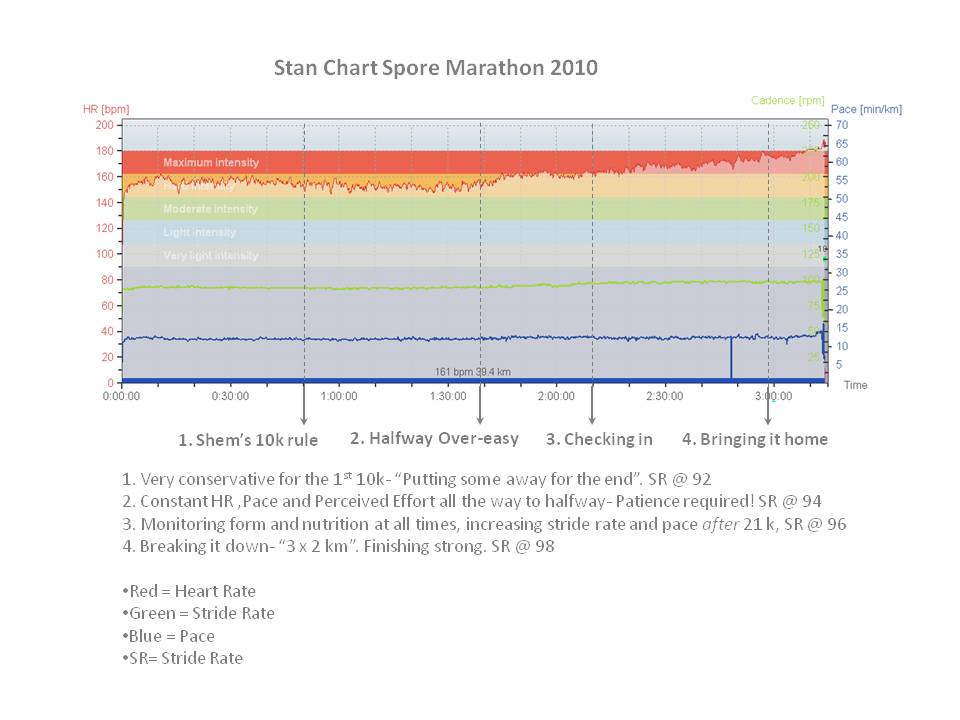
1. Shem’s 10km rule: Get the 1st 10 k out of the way without even feeling it.


“What 10?”

I thought as I passed the marker. Starting at a very conservative pace, I was conscientiously restraining myself from picking up the speed. So far so good- 10 km effortlessly down and my race had suddenly become a much more manageable 32 Km.


2. Halfway Over-Easy: Keep it easy to at least half way.


Keeping the same easy pace all the way to 16km had me feeling good. I had been “putting something aside” for the end of the race, but now, the first whispers of doubt interrupted my regular 2- 2 breathing pattern, “Too slow, you’re not going to make it at this rate. It’ll be impossible to pull it back in second half. You how hard it gets at the end, you better speed up just a little! ” I picked up the pace and felt my breathing deepen. As of in response, the exact words that I had shared with my Track Attack run class echoed in my head,


“You WILL feel like going harder- DON”T!”

The best coaches believe in their training protocols and are able to defend and justify their methodologies. This situation presented a perfect and unique opportunity to practice what I had been preaching. Do I really believe?


In faith, I slowed my pace dropped my stride rate back down to 92 and got to halfway. My legs still relatively fresh- now to see how much was left in them!


3. Check in, Zone out


I was starting to get excited. So far the race had gone according to plan and intuition told me I was in a good place. I had got to halfway at 1:40 and this would be the last time I was going to check the clock. From here on it was going to be an exercise in balancing physical fatigue with mental tenacity- a true test of both the smarts and the spirit of running.


I performed a quick check that I was still holding good form- Running tall, Shoulders relaxed, Stride Rate? I drove my elbows back just a little quicker and got them going up to 95 strides per minute. “That’s better!”


Nutritionally, I had taken in about 200 calories / hour and been grabbing water at almost every aid station. My energy levels and hydration were fine. The caffeinated gels had taken effect and my pupils were dilated in wide eyed wonder;


“You’ve worked hard get there. It’s not every weekend you’re in this position- Running well, under control, 26kms into a marathon. This is your chance- Don’t let go.”


I pealed out the 1st half a Nuun electrolyte tab and popped it into my mouth. It’s effervesant tang momentarily jolting me out of my running daze. Finding its way into the corner of my mouth, it sat there slowly dissolving as my mouth greedily soaked up the sweet, salty froth.


With all systems go I just zoned out and let my elbows do the running.


4. Break it down, bring it home


2 gels, another Nunn Tablet and 10 km later I passed the 36km marker. I was nicely surprised that my stride rate had crept up to 98 and I recognised that it must have been the stride repeats that I had thrown into the middle of my long runs.


“Better watch out for The Wall!” The Wall- that notorious Bermuda Triangle, made famous by countless marathon horror stories the world over- that hits you all at once and reduces your best effort to a whimpering walk. But The Wall never came.


By breaking down the distance into shorter manageable bits, interval training encourages your body to hold perfect running form, reinforcing good running habits. This becomes especially important in the closing stages of any race when the body is already fatigued and close to its limit. With 6 km to go, I was transported back into a recent Track Attack session;


“3 x 2km”


This was not new ground; we had practiced this during class, at race pace, holding good form. It gave me the confidence to speed up and run hard without fear. Soon it was 2 x 2km, “You can do it”, and then 3 x 1km, “You’re there- Hang on!”


My heart leapt as I turned the last corner and saw the race clock- 3:13! I sprinted down the finishing chute and crossed the line in disbelief at what had just happened- I was speachless! 


Looking back, I will always remember this race for long time. Not only was it a HUGE learing experience in marathon running, but also because it is a tremendous affirmation for me as a coach to continue believing in what I am passionate about... .


Tuesday, September 29, 2009

More new toys!

We're getting this fantastic new toy... I mean tool.. soon. It will help you choose the right running shoes.

Bauerfeind had the genius idea to make insoles out of pressure sensitive material that would fit nicely into your running shoes. When hooked up to the transmitter, it sends the real time colour coded pressure data to your laptop that displays the pressure changes in your footbed as you run.. incredible stuff! 


Insoles strapped on


Transmitter ON


Away we go!
(Check the high stride rate BTW: )

Wish I had taken a picture of the screen display, thats the most impressive bit. Will keep you all posted when it comes into the store so you all can come in and have a go. You'll be amazed : ) Shem